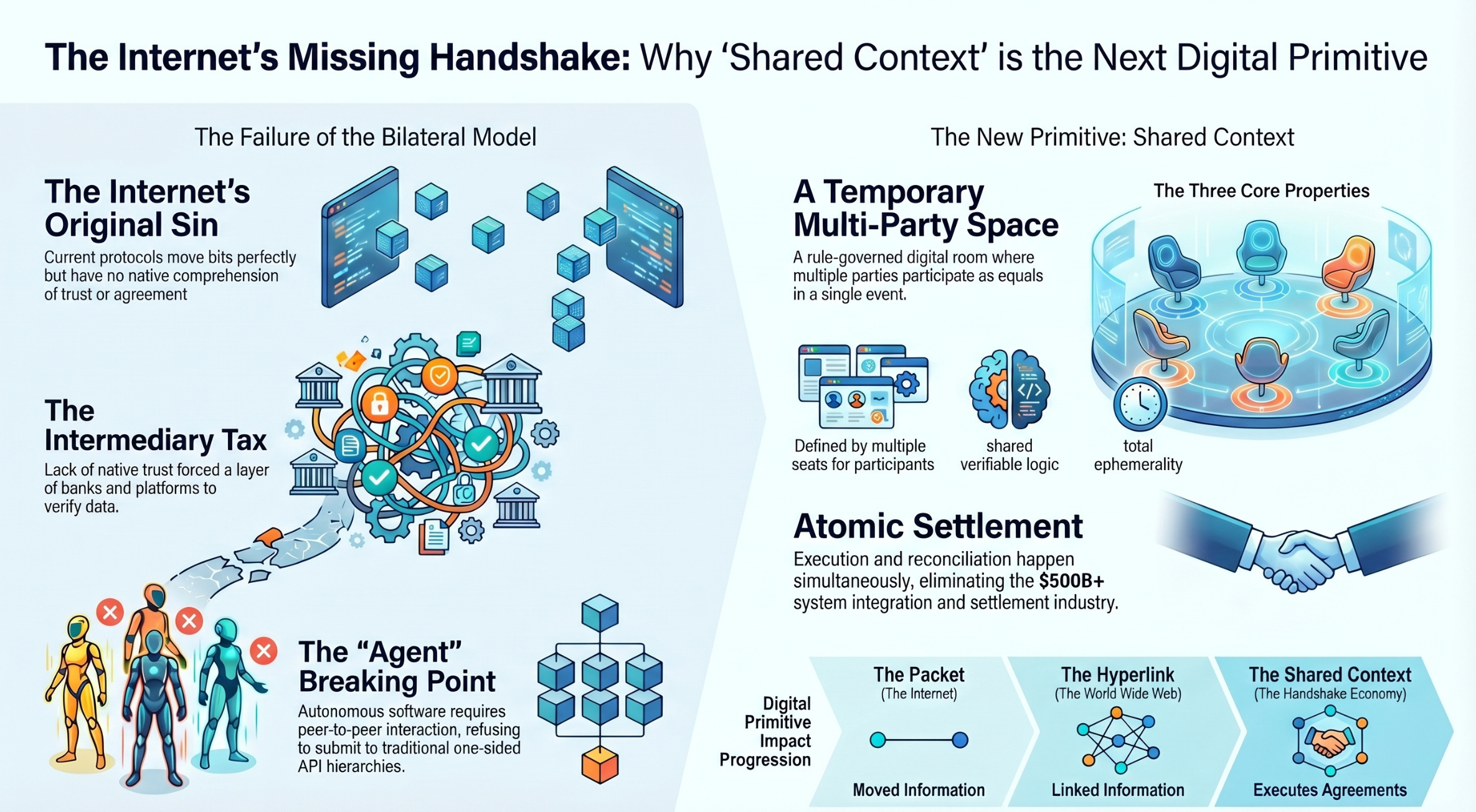
Every few decades, a new digital primitive emerges and rearranges civilization. The packet gave us the internet. The hyperlink gave us the web. The app gave us the mobile economy. Each time, the people who recognized the primitive early built the next generation of institutions. The people who mistook it for a feature built products that aged badly.
We are at another such moment. And almost everyone is looking in the wrong direction.
What the Internet Got Right
The internet solved one of the hardest problems in human history: moving information between strangers at zero marginal cost. TCP/IP did not care what the information meant, who sent it, or whether it was true. It simply guaranteed that bits would arrive intact. This was a masterpiece of engineering, and it was enough to trigger forty years of exponential transformation.
Everything we built on top — the web, email, social media, streaming, e-commerce — is a variation on one theme: copying data from one place to another with perfect fidelity. The entire digital economy runs on a network that moves descriptions of reality. Catalogs. Messages. Records. Statements. PDFs of contracts that someone printed, signed with a pen, scanned, and emailed back.
We digitized the paperwork. We did not digitize the handshake.
What the Internet Got Wrong
The internet has no native mechanism for agreement.
It can transmit a contract, but it cannot execute one. It can deliver a payment instruction, but it cannot verify that the conditions of the payment were met. It can send a credential, but it cannot confirm that the credential is still valid, that the issuer is accountable, or that the context in which it is presented is legitimate.
This is the internet’s original sin. The foundational protocols are trust-agnostic. They move bits with perfect fidelity, but they have zero comprehension of what those bits mean.
The consequences shaped the entire economy. Because the network could not verify agreements natively, we built a global layer of intermediaries to do it on our behalf. Banks verify payments. Clearinghouses verify trades. Certificate authorities verify identities. Platforms verify reputation. Each one operates a private silo of “truth” and charges a fee for access.
This is the architecture we live in. A network that moves information at the speed of light, wrapped in a bureaucracy that verifies agreements at the speed of paperwork.
The Fifty-Year Patch
The digital economy spent half a century trying to compensate for the missing primitive. Every major technology wave was, at its core, an attempt to solve the agreement problem without actually building an agreement protocol.
Client/server gave us a simple hierarchy: one party dictates the rules, the other conforms. This works when the interaction is one-directional — a browser requesting a page, a terminal querying a database. It fails the moment both parties have demands, because the architecture has no mechanism for negotiation. One side must submit.
Web services added documentation to the hierarchy. SOAP gave the server a machine-readable description of exactly how the client should conform. REST gave the hierarchy a philosophical framework. Microservices shattered the monolith into fifty smaller hierarchies. The power dynamic never changed.
Blockchain attempted a radical solution: replace the intermediaries with a shared global ledger. The insight was genuine — if everyone can see the same truth, nobody needs a middleman. The execution was fatal. A global ledger forces every participant to agree on one vocabulary, one governance model, and one consensus mechanism. It traded institutional bureaucracy for computational bureaucracy and called it decentralization.
Stablecoins retreated further. They abandoned the ambition of a new financial system and settled for digitizing the most primitive form of money — the bearer instrument. A digital object you hold, like a coin in your pocket. This is a regression to barter logic dressed in modern cryptography.
Each wave generated enormous excitement, enormous investment, and enormous disappointment. Because each wave was building on top of the same broken foundation: a network designed for moving information, pressed into service for managing agreements. The patches got more sophisticated. The underlying problem remained untouched.
Why It Breaks Now
For fifty years, the missing primitive was tolerable because one side of every interaction was a human. Humans are slow, patient, and adaptable. They will learn a new API. They will re-enter their credentials for the fourteenth time. They will wait two days for settlement, fill out redundant forms, and hire consultants to reconcile mismatched ledgers. Humans absorb the friction that the architecture creates.
That era is ending.
The economy is filling up with autonomous software that acts on behalf of people and organizations. These agents negotiate contracts, verify credentials, execute trades, and manage supply chains. They operate at machine speed, around the clock, across jurisdictions.
And they will not play the client.
When two agents meet, neither is willing to be the subordinate. They represent sovereign interests. They both have demands. They both require proofs from the other side. The interaction is bidirectional by nature. “I publish an API that you must conform to” breaks down the moment the other side has its own requirements. If establishing communication strictly requires each party to accept the other’s terms on the other’s terms, the interaction never starts.
Client/server cannot model this. The bilateral, hierarchical primitive that carried the digital economy for five decades has met a use case it cannot serve.
This is the crack in the foundation. Agents are the earthquake.
The Primitive
Every failed attempt to fix the agreement problem shares a structural flaw: the interaction is bilateral. Two parties. Two roles. One asks, one answers. This constraint makes intermediation inevitable, because any function beyond request-and-response — translation, arbitration, observation, escrow — must be performed by a separate system, called through a separate connection, managed by a separate integration.
The new primitive eliminates the bilateral constraint.
It is the shared context: a temporary, rule-governed space where multiple parties participate as equals.
Three properties define it:
Multiple seats. The interaction accommodates as many participants as the transaction requires. Buyers, sellers, banks, translators, regulators, arbitrators — all present in the same atomic event. Every function that the transaction needs sits in the room, rather than being called sequentially through a chain of bilateral hops.
Shared logic. The rules of the interaction are not dictated by one party’s server. They are published as inspectable, deterministic logic — a finite state machine — that all parties can verify before they commit. The rules are the physics of the interaction. They cannot be bent by any participant, including the one who proposed them.
Ephemerality. The space exists only for the duration of the interaction. It assembles, executes, issues cryptographic proofs to the participants, and dissolves. It does not accumulate history, power, or attack surface. You cannot hack a room that no longer exists.
This is the primitive. It sounds simple because primitives are supposed to be simple. The packet is simple. The hyperlink is simple. Their consequences were not.
Why This Primitive Matters
The economy is a living network of contractual relationships. Promises, obligations, rights, delegations — continuously creating and consuming each other. Every transaction is both a product of prior agreements and the raw material for future ones. A purchase order exists because an employment contract delegated authority, because a board resolution authorized the delegation, because articles of incorporation created the entity. Pull any thread and you unravel a chain of agreements stretching back to the founding of the institution.
The internet of information could describe this network. It could transmit documents about agreements. What it could never do was execute agreements natively — verify that both sides met the conditions, swap the rights atomically, and issue the proofs, all in one indivisible event.
The shared context can.
And because every context produces verifiable outputs that become inputs for the next context, the digital network finally mirrors the recursive structure of the economy itself: agreements producing facts, facts enabling new agreements, endlessly.
This is what makes the shared context the next big thing. It is the first digital primitive that matches the actual structure of the economy. The packet matched the structure of a signal. The hyperlink matched the structure of a reference. The shared context matches the structure of a handshake.
The Intermediary Question
If the shared context becomes the foundational primitive, a very large question follows: what happens to every business that exists because the primitive was missing?
The global system integration industry — the middleware, the consultants, the armies of engineers who wire systems together — exceeds half a trillion dollars a year. That industry exists because client/server forces every connection into a bilateral format negotiation. When translation becomes a runtime service performed by a participant inside the context, the permanent plumbing becomes unnecessary.
Clearinghouses exist because trade and settlement are separated in time, and someone must guarantee the gap. When settlement is atomic — when the context verifies all conditions and swaps all rights in a single indivisible event — the gap vanishes. No gap, no counterparty risk, no clearinghouse fee.
Reconciliation departments exist because every institution maintains a private ledger and must manually match it against every counterparty’s private ledger. When the transaction is the reconciliation — when both sides receive identical cryptographic proofs at the moment of execution — the matching problem disappears by construction.
Platform marketplaces exist because buyers and sellers need a place to meet, and the platform provides that place in exchange for controlling the rules, the data, and the economics. When peers can discover each other through a mesh of trusted relationships and transact in ephemeral contexts, the platform’s structural advantage dissolves.
Payment networks, certificate authorities, KYC providers, notaries, escrow agents, data brokers, regulatory reporting pipelines — every one of these exists to perform a function that the internet’s missing primitive forced out into a separate, permanent, fee-extracting institution.
The shared context does not compete with these businesses. It removes the architectural reason they exist.
Who Builds on the New Primitive
When the packet became the primitive, the winners were not the telephone companies. They understood wires, not packets. The winners were the people who understood what a world of packets made possible.
The same question applies now. Who understands what a world of shared contexts makes possible?
The obvious candidates are the institutions that already manage trust for a living: banks. They already verify identities, price risk, settle transactions, and maintain regulatory compliance. They already sit at every intersection of the economy. What they lack is the architectural primitive that allows them to do these things at machine speed, across organizational boundaries, without the intermediary chains that slow them down. The shared context is their upgrade path — if they recognize it.
The less obvious candidates are the companies building autonomous agents. They are discovering, right now, that their agents cannot operate in a client/server world. Two agents that need to negotiate cannot do so if one must submit to the other’s API. The agent builders need a peer-to-peer primitive for autonomous interaction. They need shared contexts. They may not know the term yet, but they are searching for the concept.
The wildcards are the translators. The shift from pre-agreed schemas to runtime translation creates an entirely new service category: in-context semantic mapping. Organizations that maintain certified, signed translations between incompatible vocabularies become infrastructure providers without building any infrastructure. They sell expertise and trust, not servers and licenses.
The Modesty of the Claim
“The next big thing” is a phrase that has been debased by overuse. Every funding round, every product launch, every whitepaper claims it. The phrase has become a signal of hype, and hype is the enemy of clear thinking.
So let me be precise about what is being claimed and what is not.
The claim is not that a specific product or company will dominate the next era. The claim is not that this transformation happens overnight, or that incumbents cannot adapt, or that the world changes smoothly.
The claim is structural: the internet has been operating for fifty years without a native primitive for agreements, and the economic consequences of that absence — the intermediaries, the reconciliation, the integration tax, the platform monopolies — are so deeply embedded that we have stopped recognizing them as consequences. We experience them as facts of life.
They are not facts of life. They are artifacts of a missing primitive.
The agents are arriving. The bilateral model is breaking. The primitive is emerging. The only remaining question is how long it takes for the economy to rearrange itself around it — and who is positioned to build when it does.